Seha Sarı
THE INVITATION OF LIGHT
On Power, Symbol, and Cultural Memory
Power is constructed not only through systems of governance, but also through images that render it visible. These images are rarely accidental; they are stabilized through recurring symbols and circulate within cultural memory across time.
The Invitation of Light is a painting series that focuses on animal symbols historically and mythologically adopted by different civilizations and political cultures. Within this body of work, animals do not operate as metaphors or subjective projections. They appear instead as symbolic structures already embedded within collective memory—visual carriers through which concepts such as authority, legitimacy, wisdom, and origin have been articulated.
Figures such as the wolf, the eagle, and the owl are approached not through individual interpretation, but as established visual codes. These codes have functioned across cultures as instruments through which societies narrate their beginnings, their continuity, and their claims to power. By removing personal biography from the image, the works shift portraiture away from glorification and toward representation. The human face recedes, allowing the symbolic figure to occupy the visual space traditionally reserved for authority.
The architectural sites depicted throughout the series—Çinili Köşk, the White House, Pompeii, the Library of Alexandria, and Dolmabahçe Palace—extend beyond historical reference. They function as ideological stages in which symbols are activated. Rather than serving as passive backdrops, these sites participate in the construction and transmission of cultural memory.
Light operates both as a visual condition and a conceptual instrument. It renders symbols visible, stabilizing them within the image, while simultaneously exposing their vulnerability. Under illumination, myths are reinforced even as the mechanisms behind them become legible.
The Invitation of Light does not propose admiration for historical figures. Instead, it invites viewers to consider the visual systems through which authority is produced: how symbols persist, how images circulate, and how power continues to reproduce itself through representation.
 Morning at the Çinili Köşk | 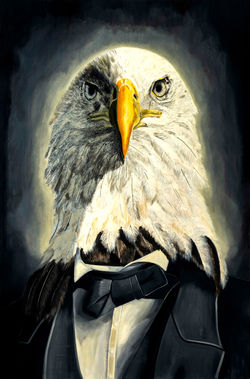 The Sound of Wings of Freedom at the White House |  A Crimson Sunset Falls over Pompeii |
|---|---|---|
 A Nocturnal Play of the Macedonian Sun in the Library of Alexandria |  A Gökbörü Is Born at Dolmabahçe |