Seha Sarı
Aphrodite
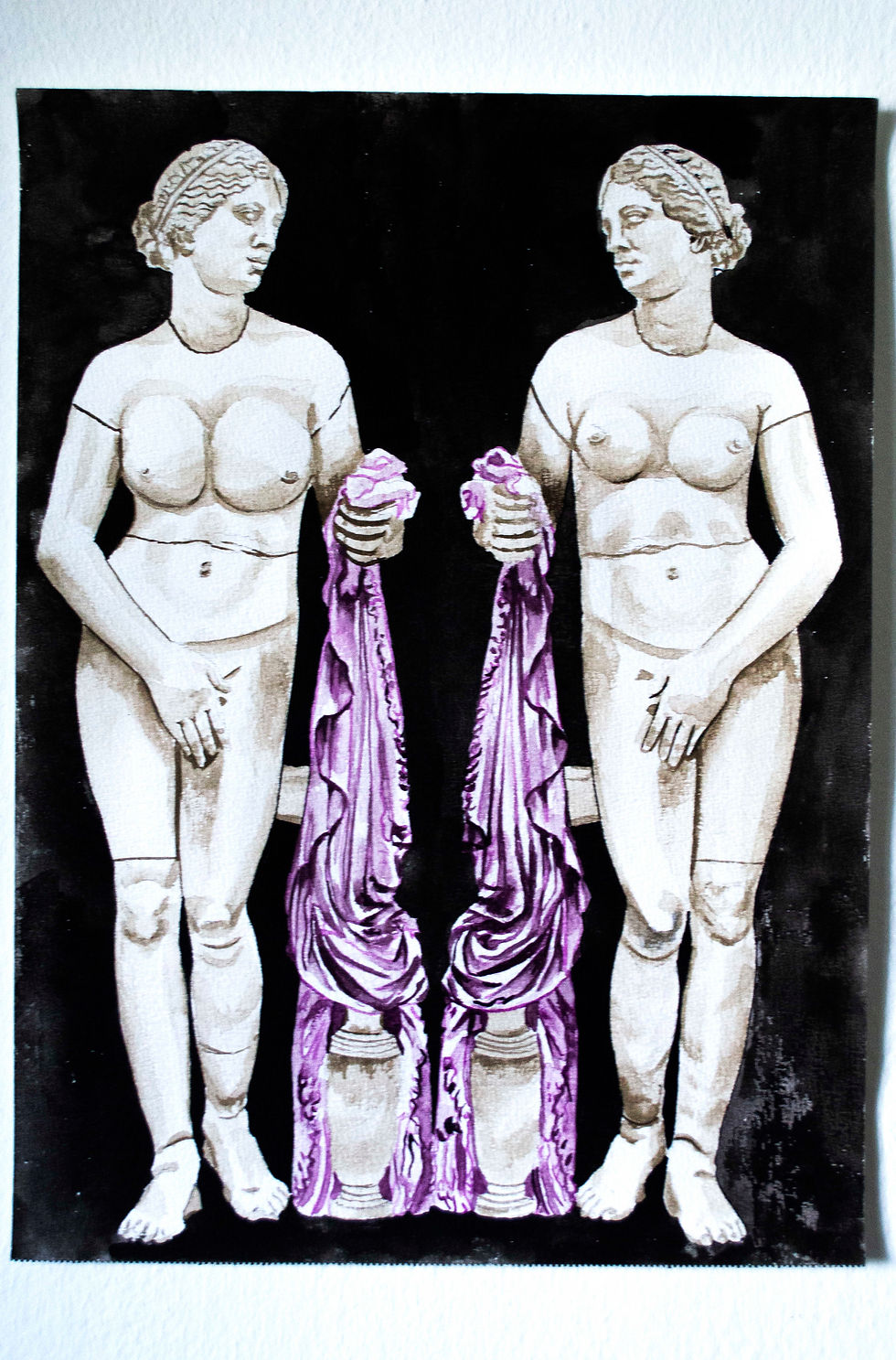
This series places the figure of Aphrodite—idealized for centuries as the goddess of love, youth, and beauty—within the contemporary politics of beauty. The timeless and untouchable bodies of ancient sculptures collide with the cold, surgical language of modern aesthetic intervention.
Here, Aphrodite ceases to be a goddess and becomes a measured, corrected, redesigned body. A body whose broken nose must be “fixed,” whose breasts are deemed insufficient for today and therefore need to be reshaped. Even divine perfection proves inadequate when confronted with current beauty standards.
Throughout the series, plastic surgery is addressed not merely as a medical practice, but as a narcotic instrument of an era in which beauty has turned into a global market. Beauty no longer heals; it is consumed, standardized, and rendered addictive. Within this system, the female body is pushed into a competitive arena—forced to measure itself against other bodies and against its own image.
While sepia tones whisper of nostalgia, aging, and maturity, sterile gloves and surgical gestures suggest the illusion that beauty can now be preserved not through time, but through intervention. Questions such as “small or large?” “young or younger?” expose how the body is stripped of its essence and reduced to a comparative object.
In the final work, Aphrodite stands before a mirror. What she sees is neither fully a goddess nor merely a reflection of a body. What confronts her is the contemporary concept of worth itself.
The slogan “Because I’m worth it” shifts here from an expression of empowerment into a question—one that asks whose approval defines worth, and at what cost.
Rather than glorifying beauty, this series interrogates who defines beauty, how it is enforced, and what is sacrificed in the process. Aphrodite is no longer an object to be gazed at; she becomes a mirror that returns the gaze—unsettling, exposing, and impossible to ignore.